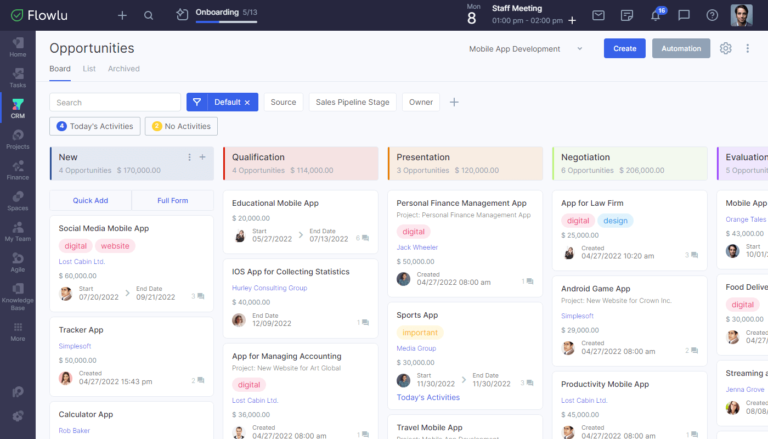
In today’s world, where maintaining excellent customer relationships is key, there is a tool that changes the dynamics of building these relationships by enhancing communication and creating high-quality customer experiences.
A Customer Relationship Management (CRM) system is such a software solution that efficiently helps manage customer needs and maintain high satisfaction (for example after-sales service or sales department activities).
What exactly does this term mean, and why is it so crucial for your businesses?
Definition of a CRM System
Firstly, CRM is not just a software; it’s a way of thinking focused on understanding, anticipating, and responding to the needs of current and potential customers.
It’s an integrated system that collects, analyzes, and utilizes data on customer interactions, enabling the building of deeper and more enduring relationships.
Key functionalities of a CRM system
Sales and Marketing Process Automation: CRM automates many daily tasks related to sales and marketing, increasing efficiency and reducing errors.
Customer Data Management: CRM allows for the collection of customer data from various channels and its centralization. This includes contact information, purchase history, preferences, and behaviors.
Segmentation and Personalization: By analyzing data, CRM enables customer segmentation and the customization of communication and offers, increasing their effectiveness.
Analysis and Reporting: Advanced analytical tools allow for monitoring key performance indicators (KPIs) and generating detailed reports.
Interaction Management: The CRM system facilitates tracking all customer contact points, including emails, phone calls, and meetings.
Why is CRM important?
Improving Customer Relationships: With a better understanding of customers, companies can create more targeted and personal experiences.
Increasing Sales: It enables more effective management of the sales funnel and increases the chances of closing deals.
Operational Efficiency: Automation and better organization significantly increase productivity.
Better Business Decisions: It provides data essential for informing strategic decisions.
Choosing the Right CRM System
The key to success lies in selecting a CRM system that best meets your company’s specific needs. Consider aspects such as ease of use, integration capabilities with other systems, scalability, and the availability of technical support.
A CRM system can assist a company in organizing work and streamlining processes, often serving as a database and process supervision hub.
Furthermore, a CRM system can enhance collaboration quality with clients and foster positive user experiences.
It’s important to pay attention to the types, varieties, and ways of using a CRM system within a company to improve its operations and optimize processes.
Ensure the CRM system meets your expectations and enables the building of communication and a database for later use. Learn how to utilize CRM in your company and the benefits of its implementation.
What Does a CRM System Include?
Depending on its structure and modules, a CRM system typically includes:
- A main database that collects information entered by your team,
- User modules with specific access levels to the database,
- Modules for specific functionalities implemented according to needs, such as:
- Customer communication,
- Analysis of data entered by the customer,
- Preparation of commercial offers, certificates, forms,
- Sales support management by salespeople,
- Registration of new users and allocation of rights,
- Work schedule and notification systems,
- Task management,
- Shared team inbox,
- Invoice generation with automatic sending to customers,
- Gathering leads from contact forms,
- Sorting leads and categorizing them into appropriate collections,
- Calendar and marking dates of meetings and other events.
How to Use CRM in Your Company
There are many ways to use CRM in your company. Depending on the system type, you can:
- Improve relationships with clients,
- Build and optimize team work,
- Enhance work quality and task automation in the company.
Using CRM, you’ll better understand your clients’ needs, learn what they expect, and how they were served by the after-sales service department.
Benefits of a CRM System
Based on the knowledge provided by data exported in reports by the CRM system, the team and business owner can make better decisions regarding client collaboration and communication methods.
It’s also beneficial to use the system for user satisfaction surveys (ex. an NPS survey).
A CRM system allows for data collection and its automatic analysis in any way.
Studies show that efficient use of a CRM system can improve a company’s sales results by over 30%. Easily.
With a CRM system, your company:
- Saves time analyzing data and operational activities,
- Improves work organization and team communication,
- Keeps client data in one place (usually it’s cloud),
- Provides essential data about teamwork and leads,
- Generates reports based on your own set parameters,
- Allows for managing contacts and automatically generating statuses,
- Saves paper and disk space as all data is stored in the cloud,
- Increases customer satisfaction,
- Boosts sales and profit.
What CRM System to Choose – Examples of CRM Systems
Unsure how to determine the right CRM for your company? Here’s what to consider when choosing a CRM system.
A CRM system should be easy and straightforward to implement, provided by a vetted and flexible company open to customizing off-the-shelf versions if available.
The system should evolve with your needs through suitable updates and the addition of extra functionalities. The implementing company should offer support for integrating new features.
What to Look for When Choosing a CRM System?
- The CRM should be secure, legally compliant (GDPR and privacy policies),
- Availability of technical support from the system provider,
- Ease of integration with apps and programs your company already uses,
- The CRM should centralize all data in one place,
- Access to historical data (most often it’s paid feature),
- Cloud-based CRM operation.
Which Companies Use CRM
There are no restrictions on specific industries that can benefit from CRM systems. Their versatility means they can be applied to virtually any type of business and industry.
CRM can be used in:
- Logistics,
- Healthcare,
- E-commerce,
- Marketing agencies,
- Telecommunications,
- Legal,
- Gastronomy,
- Tourism,
- Finance.
Examples of CRM System Operations
CRM functionality might include:
- Data export in graphical chart form,
- Automatic notifications to the team,,
- Task assignment,
- Invoicing,
- Data analysis using filters,
- User access management,
- Work organization in a calendar for different company departments.
In conclusion, selecting the right CRM system for your company is a pivotal decision that can significantly impact your operational efficiency, customer relations, and overall business growth.
By considering factors such as system security, ease of integration, functionality, and language support, businesses can ensure they choose a CRM that aligns with their specific needs and goals.
Furthermore, understanding how to effectively apply CRM strategies within various departments, can unlock new opportunities for customer engagement and sales optimization.
As the marketplace continues to evolve, the flexibility and adaptability of your CRM system will be crucial in maintaining a competitive edge and fostering long-term success.
Remember, the goal of implementing a CRM is not just about managing customer data; it’s about building stronger relationships with your customers, increasing sales and driving your business forward.